![]() |
| The Cave House |
![]() |
| Our guide Geoff |
![]() |
| Broken column |
![]() |
| Inside 'The Cathedral' |
For further information and photos: http://www.jenolancaves.org.au/choose/?rf=/
![]() |
| The Cave House |
![]() |
| Our guide Geoff |
![]() |
| Broken column |
![]() |
| Inside 'The Cathedral' |
For further information and photos: http://www.jenolancaves.org.au/choose/?rf=/
There are just so many places that you can visit and do walks from in the area. There were a couple that we wanted to look at before we left so we made a fleeting visit to have a look at one or two before we left.
Evans Lookout was the first such place and it gives you a view down into the Grose Valley just around from Govetts Leap. From here is an excellent walk called The Grand Canyon which is a three hour return trip but was too long for us late in the day.
|
| Evans Lookout. |
![]() |
| View of Sydney in the distance. |
The last spot we visited was Perry's Look Down. Once again this viewing platform was looking into the Grose Valley and its name says it all. It is a look down and the camera does not capture this feeling well. Tracks into the valley begin from this point too.
![]() |
| Perry's Look Down |
![]() |
| Even the trees have trouble! Look at the angle it is growing at! |
From the cliff edge here by the house we are staying in is a large network of tracks - up to 20 km, and we have explored several by ourselves but this morning we were lucky to have a tour guide. John lives across the road from us and his family have been in the area for around a 100 years. John can remember playing in the tracks as a child. Heaven forbid if a child were to play here today. It would be deemed too 'dangerous'. Anyway John is more than qualified to show us yet another one of the tracks, this time to the area known as the Colesseum.
This track is yet another legacy of the Hydro Majestic, the grand old hotel that dominates both the history and landscape of Medlow Bath. This particular track was built around 1893 and is an engineering feat on its own. Steps have been both carved out or constructed from stone, and knowing how little machinery would have been available makes you really appreciate what is still here to enjoy. Only one area has original wooden steps rather like a ladder in the area called the Squeeze.
It just goes to show how hard some of the local wood is, and because of its position it had also avoided any bush fires. Another ladder not far on had not fared so well and a metal ladder had been installed as a replacement. The Colesseum was an area below the escarpment and almost directly below the Hydro and hotel guests were able to walk to this area. Once down this very steep part the walking was relatively easy and flat as we made our way around to the Colesseum. Out of the westerly winds the area had a similar look to NZ bush, especially all the ferns. The waterfall helps keep the area wet all year round. A lot of rock had been shifted to create steps and stone walls and to transform it into a place for people to gather and enjoy the outdoors. It is difficult to capture all this in a photo because of the both the size of the area and the sheer cliffs above.
![]() |
| Looking into the area known as the Colesseum. |
|
| View down the valley from the Colesseum. |
![]() |
| The Colesseum is in the distant - below the blackish spot. |
The round trip took us just over two hours and once again we were glad to have ventured out.
This website has some more photos that are able to give a better perspective than I was able to get. http://www.dingogap.net.au/navigation/scenery/bluemountains/medlowbath/thecolosseum.html
A piece of Medlow Bath History: "An enjoyable day can be had exploring the lovely old walking tracks in the vicinity of the Hydro Majestic Hotel on the west side of the Great Western Highway at Medlow Bath. Most of these were professionally constructed around the beginning of the last century when Mark Foy owned the Hydro Majestic which opened on 4th July, 1904. Part of the delight of these old tracks is that they haven't suffered the desecration of safety railing overkill and ugly steel and plastic steps as have many walks within the National Park. The Grand Canyon walk at Blackheath had a similar atmosphere up until the early 1970's. This was before our current litigious society, when people assumed responsibility for their own safety. Medlow Bath was previously known as Brown's Siding or Brown's Sawmill Siding and then plain Medlow in the 1880's. The 'Bath' was added to Medlow in reference to the various bath treatments offered to the Hydro's guests.(Ref. Brian Fox and John Low).
The Blue Mountains are home to many great gardens, many of them private and available for viewing but unfortunately not at this time of the year. Two that are open all year are the Everglades Gardens in Leura, and the Blue Mountain Rhododendrons Gardens in Blackheath. For us even visiting these two gardens is about three weeks too soon for all the beautiful spring flowers that show case both of them. Of course this didn't stop us taking the time this week spend an hour or two in each one.
The Everglades Historic House and Gardens in Leura were developed by Feltex carpet industrialist Henri Van De Velde in the 1930s as his weekend retreat. Famous landscape architect Sorenson was employed for many years to design and build this 12.5 acre garden that includes both European styled gardens and bushland. Much of the work was done in the early 30s when there was plenty of labour available due to the depression years. Large excavations work was carried out with stone walls built, streams created to look like they had always been part of the landscape with a waterfall and grotto/pool. The Art Deco House compliments the garden, and all is available to view.
Further information is on their website: http://www.everglades.org.au/index.php
![]() |
| View through the "wisteria window." |
![]() |
| Man made waterfall and grotto. |
On Tuesday we visited the Campbell Rhododendron Gardens in Blackheath. Julia gave us a personal tour. We had met Julia and her husband Wayne at a gathering not long after we arrived here. Although they have lived in Australia most of their working life, Wayne was born and bred in Invercargill. Small world. They even call their own property at Blackheath "Rakiura" (the Maori name for Stewart Is and our Otatara street name.) Julia is a very keen gardener and since retiring to the Blue Mountains have created their own beautiful garden. As someone who likes to be busy she is very involved with the The Rhododendron Gardens and has just taken on the job of presidency. These gardens were built in the late 1960s and 8 hectares of this 18 hectare block of Crown Land is utilised to grow rhododendrons and many other exotics amongst the native bush. One of their aim's state that they want to show that exotic and natives can exist in harmony and this is certainly evident. It is truly an inspiration to the team of volunteers who now maintain this garden and walking trails. Spring of course is the best time to visit when, by going through the photos we have seen, it must look truly spectacular. Their festival week in early November attracts thousands of visitors, both local and tourists. We feel very lucky to have had Julia as our guide, and also that as it has been a mild winter that a number of rhodos were in flower.
![]() |
| Julia, our guide. |
![]() |
| Courtesy of their website |
More photos can be found on their website http://rhodogarden.org.au
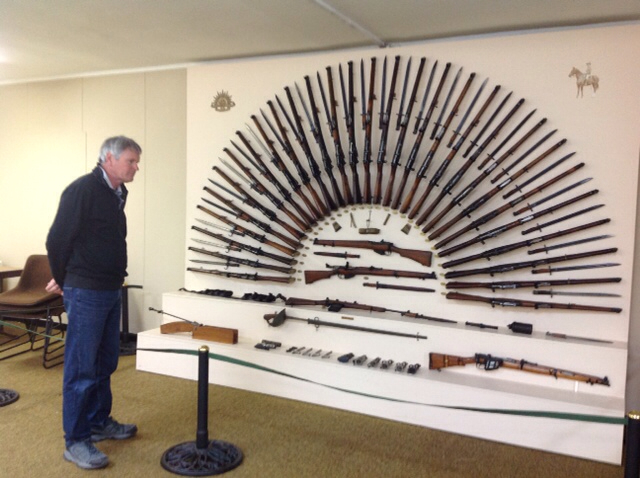
Our Saturday outing was to the Small Arms Factory Museum. Although a small museum it has plenty on offer to see, as well as a personal tour guide, to explain both the history and the exhibits.
The museum holds the largest collection of small arms in Australia, and is on the site of the original Small Arms Factory. The factory was built in 1912 to produce weapons for Australia, chosen to be so far inland as it was considered to be safe from naval attack. All aspects of weaponry were designed and manufactured here, and during WW2 some 6000 people were employed. After the end of WW2, there was a move away from just small arms and into other light engineering. Sewing machines, Sunbeam cake mixers, and shearing equipment were just some of products that they diversified into. Today the factory is still operating but in a much smaller capacity, with sporting guns now the focus.
![]() |
| One of each of the 303s produced. |
![]() |
| A private pistol collection. |
![]() |
| Pinnock Sewing Machine |
This link gives you lots of history and information if you are interested. http://www.lithgowsafmuseum.org.au/
The Blue Mountains botanic gardens are at Mount Tomah, about a half hour drive from here at Medlow Bath. One particularly sunny day, we packed a picnic lunch and headed over to walk through and view these gardens. As it says in the brochures "A visit to Mount Tomah is like travelling the botanic world." There are plants for all around the world with many of them grouped in geographic regions. It is set high (by Australian standards!) on the peak of an extinct volcano and provides a cool garden climate. The New Zealand collection was doing very well, and along side it many other collections such as the rhododendrons, the rock garden, formal garden, bog and rock garden. Tomah, from the aboriginal word, means tree fern and there were certainly lots of them, especially in the Gondwana walk. All these plantings came with lots of information boards, and in particular the Wilderness Conservation area. A viewing platform is provided here that looks across the local vegetation with Sydney in the distance. It was a little hazy and unfortunately the iPad camera hasn't done it justice.
![]() |
| Looking up at the Rock Gardens |
![]() |
| The hellebores do particularly well in this area. |
![]() |
| Looking down towards Sydney. |
These gardens are well worth a visit. There are suggested walks depending on how much time you have, from half an hour to a full day. It is certainly a place that you could return to many times and always see something new. Spring was just beginning to show itself with the camellias and early azaleas in flower, along with the jonquils and snowdrops.
There is the Blue Mountains World Heritage Exhibition Centre that has both interactive and static displays about the unique values of this wilderness area, and of course, like in any visitor/tourism facility there is the shop and restaurant.
This area is full of history that goes back 7000 years, which is the the time of the first dated rock art. Further information about the history of this area and the gardens can be found on their website at http://www.mounttomahbotanicgarden.com.au/your-visit/history/
Here we are surrounded by green and gold. Much of the native vegetation is displaying these colours at the moment with the acacias or wattles in flower. I didn't realise that there were so many species, 1300 world wide, with 960 native to Australia. In fact it isn't until you get up close and look that the differences are obvious. Here in Medlow Bath I have spotted at least two different species and I am now wondering what was the one we had at home on the farm when I was growing up. It always put on a spectacular show of yellow or gold flowers. And so it is here at the present time.
Another green and gold object we have been seeing a lot of is the 'log splitter'. What a wonderful invention this piece of machinery is. In mere seconds it can split even the largest of rings of pine into pieces just the right size for Stanley or the log fire. As I am standing there helping Stephen with it I think how much it would have saved all those pioneers from such hard labours with only the use of an axe or saw to achieve the same ends.
Tomorrow night we will be seeing another field of green and gold, this time on the screen coming from the Sydney rugby grounds. This green and gold team will be matching their skill against our famous Allblacks. We are going to be watching it with mixed company in the home of one our local community. We will be joined by Dan and his Mum, Judy both NZers and avid Allblack supporters,while the remainder of the crowd will be supporting the local team. It should be a good night.
Green and gold. The traditional Australian colours which, according to my sister, and a fact I wasn't aware of, were chosen because of the green and gold of the golden wattle, Acacia pycnantha, Australia's florall emblem. A check in Wikipedia confirms this but also goes on to say that "Gold is a reflection of Australia’s beaches, mineral affluence, arid shrub/scrublands and desert areas of the island-continent nation. Green represents the flora of its forests, eucalyptus leaves and meadowlands of the Australian countryside." It also states that "Green and gold are the traditional team colours of Australian national sporting teams, and nearly every current Australian national sports team wears them (although the hues and proportions of the colours may vary between teams and across eras)."